
published: November 25, 2013
To be sure, there is nothing wrong about a math professor—or a marine biologist, an astronaut, an alchemist, for that matter–speaking out against Professor Xia Yeliang, defending Peking University’s decision to fire the professor of Economics who “happens to be” a dissident and a critic of the communist regime, and lashing out at his Wellesley colleagues for their support of professor Xia.

PROFESSOR XIA YELIANG GAVE A LECTURE. A SCREEN SHOT OF SILENT CONTEST.
For those of you who have not been following news from China that closely, here is a quick review of the Professor Xia Yeliang Incident: Professor Xia is a professor of economics at Peking University. On October 18, the university notified him that a faculty committee voted not to renew his contract. Professor Xia’s firing made international news because it so happened that he has also been an outspoken critic of the Chinese Communist Party (CCP) regime in China, and one of the first signatories of Charter 08, a proposal for political change in China initiated by Liu Xiaobo that landed him in jail for “subverting the state power” (He now enjoys the rare distinction of being the only jailed Nobel Peace Prize winner in in the world). An ultra-anti-American, anti-West film titled Silent Contest, produced by the Chinese military that has been available recently, portrayed him as an enemy of the state along with other liberal intellectuals. The New York Times published an editorial to put the dismissal of Professor Xia Yeliang in the larger picture, an insidious pattern, of China’s effort to suppress academic freedom and political dissent.
Peking University, as well as state media, reacted promptly, declaring the decision to fire Professor Xia had nothing to do with politics and everything to do with how poor a teacher he had been and how poorly the students thought of him. A debate unfolded among many foreign journalists and China watchers. Mr. Eric Fish wrote in the Atlantic, on October 22, dismissing the outcries of American journalists and academics. He pointed out that no one had bothered to go to the university to talk to the students and find out what they had to say about Professor Xia. So he did. He didn’t explain how he found his samples (I wish he did and I actually asked him to do so on Twitter, given how diverse his samples were and how quickly he was able to identify, and talk to, them over a weekend), but he seemed to have found the near perfect sampling to reach his conclusion: Even in China, Dissidents Sometimes Get Fired Just for Being Bad at Their Jobs.
Another prompt response, largely unnoticed by English speakers, came from a “full professor of mathematics at Wellesley College” by the name Bu Qiyue (步起跃), and it was published almost simultaneously (within less than an hour) on the websites of Xinhua News Agency (Chinese), People’s Daily (Chinese) and CCTV website (Chinese) the essential mouthpieces of the Chinese Communist Party. I only read the article, written in Boston on October 21, this weekend.
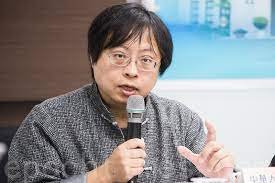
Professor Charles Bu, or Bu Qiyue (步起跃), gave a lecture in a Chinese university in 2011. Courtesy of http://news.xauat.edu.cn/read.php?classid=42&newsid=5991
PROFESSOR CHARLES BU, OR BU QIYUE (步起跃), GAVE A LECTURE IN A CHINESE UNIVERSITY IN 2011. COURTESY OF HTTP://NEWS.XAUAT.EDU.CN/READ.PHP?CLASSID=42&NEWSID=5991
From the start, it was clear that Professor Bu was deeply irritated by over a hundred of his Wellesley colleagues who, “without any factual bases, jointly wrote an open letter to accuse Peking University of obstructing Professor Xia’s academic freedom and declared that the cooperative relationship between Wellesley and Peking University shall be reconsidered.”
Most of these hundred Wellesley professors “have never even been to China, and have even less an idea about the School of Economics of Peking University,” Professor Bu continued. “What makes them think they can point fingers at the internal affairs of a university on the other side of the planet?”
“Americans are used to freedom, especially on a noble issue such as academic freedom. So they responded with eagerness, signed their names in haste without thinking. However, ‘listen to both sides and you will be enlightened; heed only one side and you will be benighted.’ It only shows that even professors at a top American private college like Wellesley can be prone to such low-grade mistake when they only listen to one side.”
I would imagine Professor Bu doesn’t know either what was going on at the School of Economics of Peking University from Boston. He didn’t seem to think he is making the same mistake of listening to one side only when he quoted the decision of the School’s Faculty Evaluation and Appointment Committee to make his counter argument. While the side that supported Professor Xia has a well-documented pattern of suppression from which to draw their conclusions, the fact remains that in Peking University, there are plenty of inept professors who comfortably keep their jobs even though they are hated by students. I know this because I was a student there.
And what Professor Bu has to say next is anything but apolitical despite the article’s apolitical title In American Universities Faculties Also Have to Be Evaluated to Get Contract Renewal:
“It is worth noting that American media has been lopsided in their accusation of Peking University. This is probably the work of the cold war thinking in ideology. The American media have always cared and loved Chinese dissidents the most. Impartialness has long been inexistent in their coverage of China. On Tibet and on the Olympics, examples abound. This is why the New York Times and other American media outlets have a bad reputation among Chinese intellectuals, especially among young Chinese.”
Really? Chinese intellectuals and young people hate the New York Times? That’s news to me. I do know that China’s Great Fire Wall blocks all the sites of foreign media and social media such as Twitter and Facebook, and has long been using tactics to obstruct the work of foreign journalists in China from denying visas to outright personal threats.
On October 29, Professor Bu opined again, this time in English in The Wellesley News. He applauded the partnership between Wellesley and Peking University at length, and then he again criticized the one-sided coverage of American news media. “It is worth noting that Professor Xia’s case has attracted disproportionate coverage from U.S. news media, mostly one-sided. The reason for the outcries perhaps is that Professor Xia happens to be an outspoken activist against the Chinese government. Anyone familiar with China’s history knows that PKU is the most liberal university in China. All of the student movements in Chinese history originated from that campus. PKU faculty members are known to be outspoken about their political views which cover the whole political spectrum. Nobody has ever been fired for political reasons.”
Now, I’m really scared to reach the end of Professor Bu’s paragraphs. What a stop.
Professor Bu is right about that there have been many outspoken faculty members in Peking University, but that’s a quality, and courage, of these faculty members and not by the sanction of the university authority, which, as all universities in China, is under the strict control of the CCP. The truth is, free thinking has always been monitored closely and insidiously trammeled through varying methods. One of which is student reporting. Some of Professor Xia Yeliang’s students “complained” to school officials about him talking about the political and economic disasters in the Mao Zedong era in the classroom. This spring, the CCP stepped up control over university teaching by issuing a gag order to universities, known as the “7 no-mentions” (七不讲), that bars discussion of Western constitutional democracy, universal values of human rights, media independence, civil society, pro-market neo-liberalism, and nihilist criticisms of the party’s traumatic past.
I don’t know what time span the word “ever” covers when Professor Bu says “Nobody has ever been fired for political reasons.” It’s a ridiculous untruth if we go back to the 1950s, a terrible lie if we go back to the 1960 and 1970s, and a willful whitewash if we consider the faculties and students who were “disciplined,” fired, or put in jail in the wake of the Tian’anmen square democracy movement, from which Professor Bu might be a beneficiary.
(After the bloody crackdown, President H. W. Bush issued the Executive Order 12711 to defer deportation of Chinese nationals and their direct dependents who were in the US between 5 June 1989 and 11 April 1990, and gave them employment authorization. On May 21, 1992, the Senate passed The Chinese Student Protection Act of 1992 to grant green card—also known as the “Blood Card”—to all Chinese who were born in China and entered the US before April 11, 1990. An estimated 100,000 benefited from the Act, and Professor Bu, a Chinese student at the time, his family and friends were likely among them.)
I digressed. Readers interested in researching more examples of political persecution at Peking University in the 1990s can look up these names: Chen Po (陈波, Department of International Studies), Wang Tiancheng (王天成, Department of Law), and Yuan Hongbing (袁红冰, Department of Law).
A more recent case was Jiao Guobiao (焦国标), an associate professor of journalism at Peking University until he was fired for writing the article Crusade against the Propaganda Department in 2005. “The university announced that I left the job of my own initiative,” professor Jiao told the Voice of America (Chinese). “But I have been persecuted by the university since I published the article. First they barred me from teaching the undergraduate, then, the graduate. After that they tried to transfer me from the School of Journalism to the Center for Ancient Chinese Classics & Archives. I rejected it. The university was planning to fire me for rejecting the transfer. Right around that time, I was invited by the US National Endowment for Democracy for six-month academic research. The school opposed my trip to the US, but I came anyway. Now they punished me and announced that I had left my job at the university.”
I took pains to translate Professor Jiao’s explanation in order to show that, obstruction of academic freedom and punishment of political dissent come in different forms – often in more insidious forms than outright expulsion, such as secret monitoring and reporting by student party members, warning, non-promotion, teaching ban (Chinese), etc. This is particularly true today when Chinese universities are seeking more and more international alliances and trying to raise their profiles while benefiting from top-tier researchers around the world. They need to make their foreign counterparts believe they have academic freedoms, and they cannot afford to fire professors one after another for political reasons without losing their coveted “international cooperation.” For example, someone argued that, “Look, Peking University has not fired Professor He Weifang (贺卫方), and that goes to show Professor Xia Yeliang wasn’t fired for political reasons.” Well, no, the most obvious reason for keeping Professor He Weifang would be that Peking University will lose an arm or leg if they fire Professor He Weifang. Has He Weifang been pressured over the years? Google it for yourself, or better yet, talk to him.
On November 3rd, Professor Bu wrote again on the topic, this time in a letter to The Chronicle of Higher Education to bring its attention to the “only article from the U.S. that offered balanced view,” the Eric Fish piece in The Atlantic.
In all three articles, Professor Bu cited how important the Sino-US relationship is and what a success the partnership between Wellesley College and Peking University has been and must continue.
Well, Wellesley faculties have already voted to continue that partnership and no one in the world thinks the Sino-US relationship is unimportant. Professor Bu must have breathed a sigh of relief.
Now, has Professor Bu been writing as someone, anyone, who just happens to have an opinion about the matter, or is there more to it?
In April of this year, the website of Chinese Communist Party Changzhou Committee’s Department of United Front Work published a feature story (Chinese) about Professor Bu, titled Changzhou Bu Qiyue: Rewrite the History of a Famous American University. We learned that he was the first Chinese to become the Chair of the Board of Admissions at Wellesley; that among Wellesley’s many distinguished alumni are two Secretaries of the State, Albright and Hillary Clinton, as well as Soong May-ling, wife of Chiang Kai-shek, and Bing Xin, a prominent Chinese writer of the last generation; and that Professor Bu has been retained as an “overseas commissioner” of The Federation of Overseas Chinese of Changzhou since 2006.
(The official website [Chinese] of the organization describes it as “a people’s organization under the leadership of Chinese Communist Party Changzhou Committee.” It is a unit in the Chinese People’s Political Consultative Conference. “Upholding high the patriotic, socialist flag, focusing closely on the Party’s central tasks, the Federation for more than two decades……has carried out all items of works….and contributed to the building of socialist modernism and the unification of the fatherland.” According to its bylaw [Chinese], it is financed by taxpayer’s money.)
We also learned from the same article that Professor Bu and his family had once been received by a ministerial level Chinese official with a banquet at Diaoyutai State Guesthouse (钓鱼台国宾馆), the place where Chinese government receives foreign leaders and dignitaries.
Professor Bu and Li Zhaoxing (李肇星), former Chinese ambassador to the United States and former foreign minister of China.
PROFESSOR BU (RIGHT) AND LI ZHAOXING (李肇星), FORMER CHINESE AMBASSADOR TO THE UNITED STATES AND FORMER FOREIGN MINISTER OF CHINA. COURTESY OF HTTP://SJTU.CUEPA.CN/SHOW_MORE.PHP?DOC_ID=81956
That’s really impressive for a non-Nobel winner overseas Chinese. Has Professor Bu solved any crazy problem the like of Goldbach Conjecture? The common impression you get from reading Chinese newspapers is that Nobelists of Chinese descent and math supermen get that kind of treatment, but apparently Chinese leaders befriend other types too.
As recently as last month, Professor Bu was received by the deputy director and Chairman of CCP Changzhou’s Department of United Front Work and the chairman of The Federation of Overseas Chinese of Changzhou.
A screenshot of the search result of Professor Bu’s article.
A SCREENSHOT OF THE SEARCH RESULT OF PROFESSOR BU’S ARTICLE.
In any case, I wonder, what channels one must go through, and what kind of coordination it takes, for an article by someone outside the Chinese government’s propaganda system on its very top level, and even outside China, to be posted not only on the site of China’s three most prominent propaganda organs almost simultaneously, but almost all other major state-owned media outlets as well, including Global Times (环球时报), China News (中新社), China Radio International (中国国际广播电台), and even a military site and many more? When I posed this question on Twitter, a tweep pointed out that, while Xinhua, People’s Daily and CCTV are all mouthpieces, they administratively belong to the State Council, the CCP Central Committee, and the State Administration of Radio, Film and Television respectively, and the only authority that can get all media outlets to do something concertedly is the CCP’s Department of Propaganda.
As I researched for this article over the weekend, I learned that Wellesley’s Freedom Project is going to invite Professor Xia Yeliang to be a visiting fellow. I hope this materializes. It looks like Wellesley could be having more arguments over Mr. Xia where he has strong supporters and also at least one formidable detractor. Writing this post, my hope is that Professor Bu, in future discussions of Professor Xia, will be forthcoming about his close ties with CCP and the Chinese government. Nothing is wrong with having such ties, right? But many will agree that it is problematic to hold back such extraordinary ties from his Wellesley colleagues while criticizing their support for Mr. Xia, and Professor Bu owes his colleagues some perspective and balance.
(Thank tweeps @ZhouFengsuo, @fightcensorship, @HengHe and others for their help.)
【Update】
The following is a response from Mr. Eric Fish. When I wrote this piece, I was not aware of what he had subsequently written about the topic since his Atlantic piece. The only reason I mentioned his article at all is because it has some relevance to my discussion of Professor Bu.
Ah how easy it is for misrepresentations to flow and outright falsehoods to be reported when you don’t bother seeking comment from someone before putting words in their mouth. Amazingly, literally every word said about me (Eric Fish) in this piece managed to be false.
First of all, I did explain how I found my sources on Sinica several weeks ago:http://popupchinese.com/lessons/sinica/in-the-news
Secondly, as I’ve repeated probably at least a hundred times since that piece came out, I never “dismissed the outcries of American journalists and academics.” I don’t at all rule out that politics played a factor. But things tend to be a bit more complicated than the simple “bad teaching OR political persecution” false contradiction that’s dominated the debate on this issue. In my piece, I just reported what students said and devoted about half my article to Xia’s side of the story.
Thirdly, I never said “no one bothered to go to the university.” I said very few did. I know Andrew Jacobs talked to some current students prior to my piece, but I wasn’t so interested in talking to current students. Xia has known since the beginning of summer that this vote was coming up. If it were me, I’d dramatically change my teaching methods, so I wanted to contact students going back several years. And as it turns out, journalists Valentina Luo, Helen Gao AND Andrew Jacobs have since also found students saying the same things I found.
Fourthly, I didn’t find my sources “in a weekend.” I started looking a few days before Xia was officially fired because that’s when a random conversation with a PKU student alerted me to this story. Altogether I think it took about 5 days.