
24 September 2014 Last updated at 05:08 ET

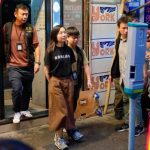
Students attend the rally at Chinese University on September 22, 2014 in Hong Kong
Students in Hong Kong want genuine universal suffrage for the special administrative region of China
“When dictatorship becomes a fact, revolution becomes a duty.”
A T-shirt slogan seen in China this week. But this is not President Xi Jinping’s T-shirt, nor is it merchandising from the Chinese Communist Party.
Instead the call to arms is emblazoned across the chest of a student in Hong Kong.
Thousands are boycotting classes this week, gathering instead on a university campus wearing yellow ribbons and waving placards; a determined but peaceful exercise in people power and all of them saying the same thing: “I want my voice to be heard. We want real democracy. Genuine universal suffrage for Hong Kong.”
But T-shirt slogans reading ‘”dictatorship fact, revolution duty” have an uncomfortable ring to an avowedly revolutionary government.
Stability and prosperity
The fact is that on the eve of the 65th anniversary of China’s communist revolution, political script lines have got strikingly muddled.
On the same day Hong Kong students were telling me they had to stand up and be counted, the leader of the party which came to power in 1949 promising justice for the workers and peasants was having his photo taken in Beijing with Asia’s richest man, Li Ka-shing, and other Hong Kong tycoons, all of them insisting that stability and prosperity must come first.
The simple explanation is that in the six and a half decades since the founding of the People’s Republic, China’s communists have gone from being a party of revolution to one of reaction.
On Hong Kong as on the mainland, they are the vested interest and jealous guardian of the status quo.
And as President Xi Jinping moves to close down all discussion of political reform in mainland China, tiny Hong Kong has become the last holdout for a fight over values.
David and Goliath
Historically Hong Kong has often been a change agent in the politics of China.
As far back as the 1911 revolution against the Qing imperialists, free speech and assembly under the British colonialists allowed China’s first revolutionary hero Sun Yatsen to gather his disciples and marshal his arguments.
And now Hong Kong is in the spotlight again, not because its citizens are bidding to change the politics of the mainland but because some are locked in a David and Goliath battle of defiance, daring to complain that Beijing is breaking its promises.